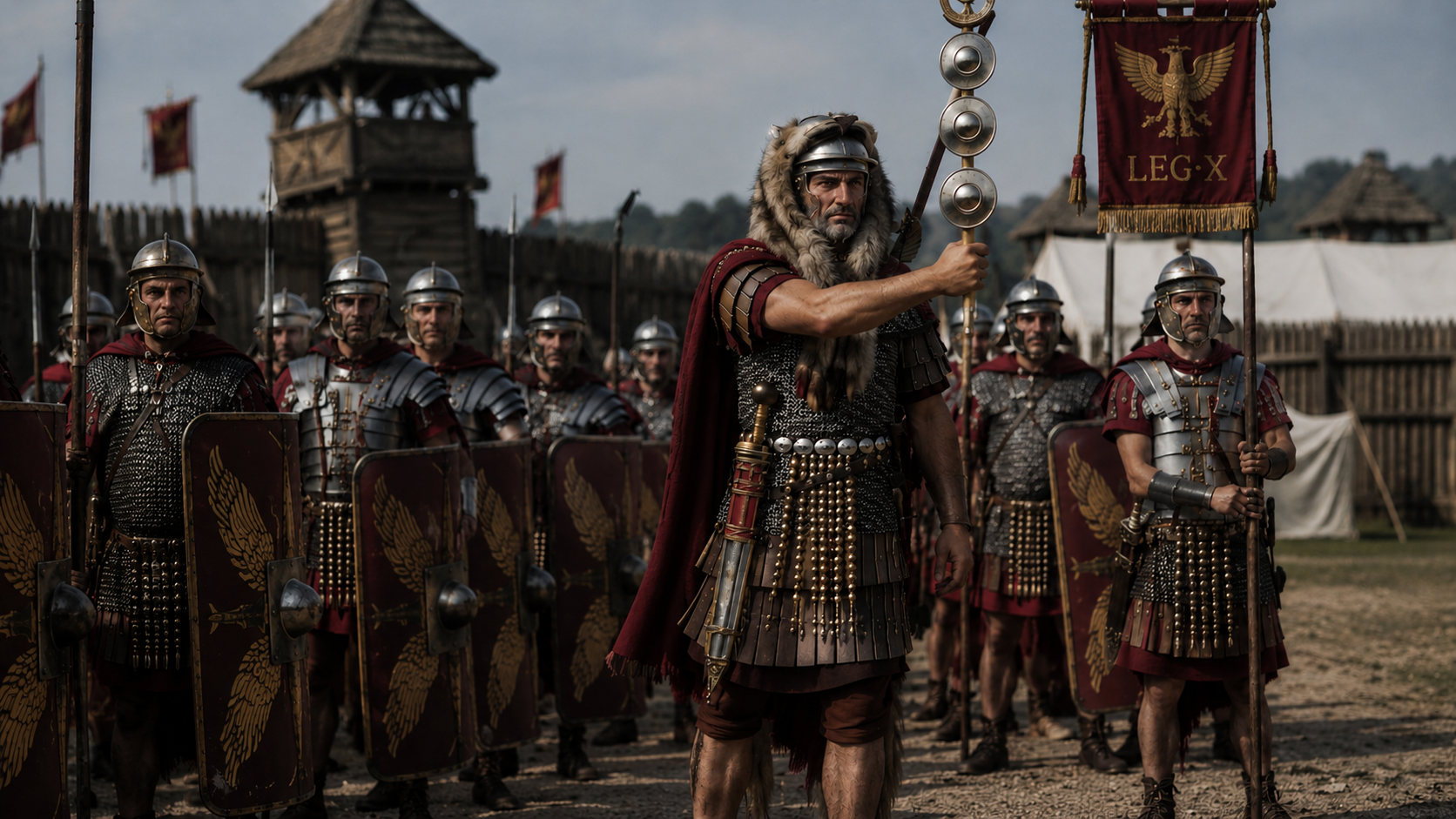
 The Legion – ready to conquer the world
Over time, the Roman legion underwent many changes. These changes particularly concerned the strength of the armed forces as a whole and the established strength of individual legions. The latter was often subject to the interpretation of the emperor or the Senate. Thus, the established strength of a single legion during Roman times varied between 3,600 and 6,100 legionaries. The greatest variation concerned the total strength of the Roman army. Chroniclers and recent research have produced contradictory information. Politically motivated statements and reports make precise conclusions even more difficult. This is still an important factor in assessing credibility and objectivity today.
Another factor was Roman defeats. Raising and training a legion was a lengthy process, so after a lost battle the overall strength of the army remained reduced for a considerable period. If Valerius Antias is to be believed, on 6 October 105 BC at the Battle of Arausio (modern Orange on the Rhône), 80,000 legionaries and approximately 40,000 camp followers were killed by the Cimbri and Teutons. Supposedly only ten legionaries survived. Since Antias was known as an “exaggerator”, these figures should be revised downward. At the Battle of Cannae (Second Punic War), 60,000 legionaries were reportedly killed and 12,000 captured. These figures are now considered relatively reliable.
Thanks to Tacitus, we have more precise reports and therefore more precise figures for the battle in AD 9 between Arminius (c. 17 BC – AD 19) and Varus at Kalkriese near Osnabrück (Teutoburg Forest). Approximately 25,000 legionaries and auxiliary troops died in this annihilation battle.
Research becomes hazardous when it relies on only a few reports and ignores contemporary factors. These include the total population of the time, epidemics and disease, lost battles and the time required to raise new legions.
The claim that the Roman army supposedly had up to one million soldiers under its command is easy to challenge. Even today, no people can call up more than one tenth of its total population for military service without risking the loss of its economic structures and its ability to fulfil social obligations. Under such conditions, the Roman Empire could not have existed for such a long period.
Taking all known and trustworthy sources into account, we can assume today that in relatively peaceful times, or during its heyday in the imperial period, the Roman army numbered about 400,000 soldiers. This total did not consist solely of the Roman elite units (legions), but also included auxiliary troops, cavalry (alae = mounted troops) and naval units.
;) Before and during the Republic
Before and during the Republic;) Before and during the Republic
Before and during the Republic;) During the Republic
During the Republic;) During the Imperial Period
During the Imperial Period;) Praetorians during the Imperial Period
Praetorians during the Imperial Period